

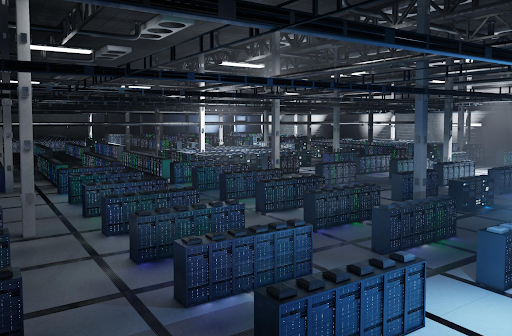
Most companies treat availability like brakes in a car: they only notice it when it fails. A tier 3 data center prevents that scenario by allowing maintenance to be carried out without interrupting operations while remaining more affordable than the highest tier 4 level.Why has Tier 3 become the standard for infrastructure that businesses rely on? And why can cutting costs by choosing a lower tier turn out to be the most expensive compromise of all? The answers lie in the following sections.
Before looking at why Tier 3 comes out on top, it is important to understand the scale against which the entire industry is measured. Data center tier standards are not a marketing label; they provide a measurable description of how much downtime an operation can tolerate. The gap between the four tiers is substantial in both cost and reliability.
Tier Classification: Four Levels, Four Budgets
Uptime Institute, which introduced the classification system in the mid-1990s, divides data centers into four tiers. Each higher tier incorporates the requirements of the tier below and adds another layer of protection. The annual availability figures commonly used across the market differ by hours between the two ends of the scale:
- Basic infrastructure without redundancy places Tier I at 99.671% availability, with up to 28.8 hours of downtime per year.
- Partial redundancy in power and cooling raises Tier II to 99.741% availability and around 22 hours of downtime.
- Multiple power paths with N+1 redundancy place a Tier III data center at 99.982% availability, with a maximum of 1.6 hours of downtime.
- Fully redundant 2N or 2N+1 systems raise Tier IV to 99.995% availability and just 26.3 minutes of downtime per year.
Uptime Institute itself no longer states these percentages in its current standard, but the market still uses them as a clear shared language.
What Makes a Tier 3 Data Center the Current Standard
The answer lies in one term: concurrent maintainability. The ability to perform maintenance and repairs without interrupting live operations. A tier 3 data center is built around N+1 redundancy, meaning that every critical component has at least one backup. Power and cooling are also delivered through multiple distribution paths. As a result, planned maintenance on one component does not bring down running systems, and that is exactly what continuous operations require.
The figures show why this matters so much. According to ITIC’s 2024 survey, a single hour of downtime costs more than $300,000 for over 90% of mid-sized and large companies, while 41% reported losses of between $1 million and $5 million per hour.* Compared with figures like these, Tier III redundancy pays for itself before an operator has time to blink.
Tip: Explore how TTC Teleport delivers reliable infrastructure in practice.
Why a Tier 3 Data Center Is Enough for Most Businesses
The move from Tier III to Tier IV sounds appealing until the bill arrives. The difference in availability is only around 90 minutes per year, yet infrastructure costs can double. This is because the 2N model duplicates every system and equips it with independent power sources. The vast majority of commercial applications will never need that level of redundancy.
Investing in Tier IV makes sense where every second of downtime creates measurable losses in the hundreds of thousands—for banks, stock exchanges, major online retailers, or public-sector institutions. For everyone else, the equation is simple: a proactively managed tier 3 data center with high-quality monitoring offers greater real-world reliability than neglected infrastructure one tier higher. What matters is the provider’s operational culture, not just the certification stamp.
A Lower Tier, a Higher Risk
The opposite extreme is found among companies that cut costs by choosing Tier I or Tier II. The lower price tag hides a major limitation: neither tier supports maintenance without downtime. Every service intervention or component replacement interrupts operations because there is no second distribution path and no backup capacity for critical systems.
In practice, this can mean 22 to 28 hours of downtime per year and a single point of failure capable of bringing down the entire system. For businesses serving real customers and processing transactions, this is a gamble where the loss can cost far more than the savings on rent. That is why secure colocation at the Tier III level is not a luxury. It is insurance against risks that quietly build up over time.
Reliability as a Sensible Investment
Choosing a data center tier affects both cash flow and whether the next outage brings your business to a standstill. A tier 3 data center strikes the point where reliability stops being a cost and becomes a competitive advantage. It remains the best choice wherever operations cannot afford to stop, but the budget cannot justify unnecessary extra zeros.
