

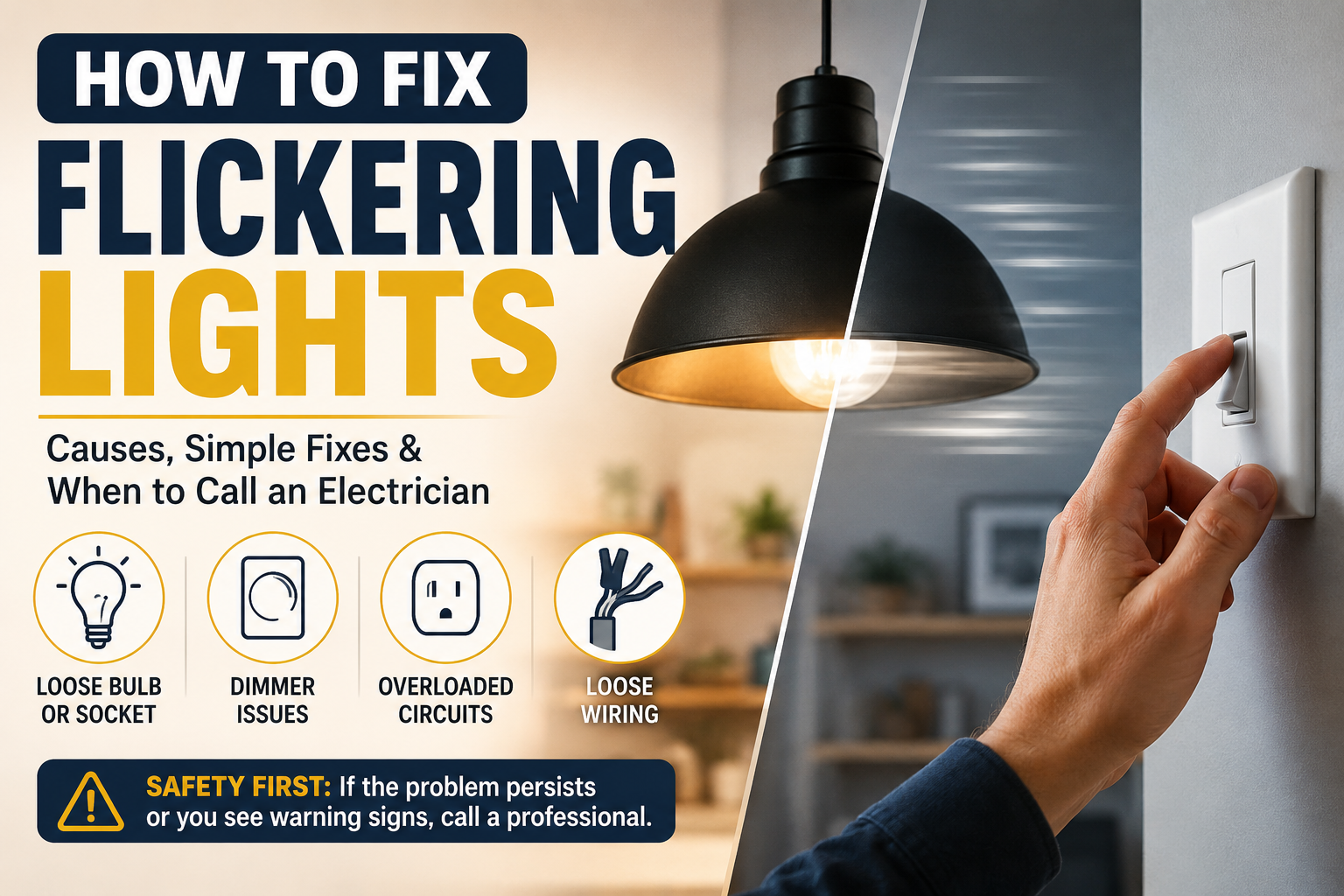
Flickering lights can be annoying, but they can also be a warning sign. Sometimes the fix is as simple as tightening a bulb. Other times, the problem can point to a loose wire, an overloaded circuit, or a faulty switch.
The good news is that you can check a few simple things safely before calling a professional. The key is knowing where the safe line is. As many electricians say, “A small flicker is not always dangerous, but ignoring a repeated flicker is never smart.”
This guide explains how to fix flickering lights in a clear, practical way. You will learn what to check first, what causes the problem, and when it is time to stop troubleshooting and call an electrician.
What Flickering Lights Usually Mean
A flickering light means the flow of electricity to the bulb is not steady. That can happen because of the bulb, the socket, the switch, the dimmer, the wiring, or even a large appliance pulling power.
If only one lamp flickers, the problem is usually close to that lamp or fixture. If many lights flicker at the same time, the issue may be deeper in your home’s electrical system.
Think of it like water pressure. If one faucet sputters, the faucet may be the issue. If every faucet in the house sputters, the main supply needs attention.
Before you panic, start small. Many flickering light problems come from simple causes that are easy to spot.
Safety First Before You Touch Anything
Before learning how to fix flickering lights, remember one rule: never work on live electrical parts. If you need to inspect a fixture, switch, or outlet, turn off the power from the breaker first.
Do not remove switch plates, open fixtures, or touch wires unless you know the power is fully off. A light switch being off does not always mean the wires are safe.
You should also stop right away if you smell burning, hear buzzing, see sparks, or feel heat near a switch or outlet. These signs need professional help.
A safe homeowner checks bulbs, plugs, and basic settings. A licensed electrician handles wiring, panels, breakers, and hidden electrical faults.
Start With the Bulb
The easiest step in how to fix flickering lights is checking the bulb. A loose bulb can flicker because it is not making steady contact with the socket.
Turn the light off and let the bulb cool. Then gently tighten it. Do not force it, because over-tightening can damage the socket.
If the bulb still flickers, replace it with a new one. Old bulbs can flicker near the end of their life, especially older incandescent bulbs.
For LED bulbs, make sure the bulb is high quality and designed for the fixture. Cheap LEDs can flicker more often because they may not handle power changes smoothly.
Check the Light Socket
If a new bulb still flickers, the socket may be worn, dirty, or loose. A weak socket connection can cause the bulb to blink on and off.
Turn off the power before inspecting the fixture. Look for dark marks, corrosion, cracks, or a loose bulb base. Do not touch the inside of the socket while power is on.
If the socket looks damaged, do not keep using it. A damaged socket can heat up and become unsafe.
In that case, the safest fix is to replace the fixture or have an electrician repair the socket.
Test a Different Bulb Type
Sometimes the bulb and fixture simply do not work well together. This is common with LED bulbs, smart bulbs, older fixtures, and dimmer switches.
Try a different bulb from a trusted brand. Use the correct wattage listed on the fixture. Never use a bulb with a higher wattage than the fixture allows.
If the flicker stops with a different bulb, the first bulb was likely the problem. This is one of the easiest wins when learning how to fix flickering lights.
If the flicker continues with several bulbs, the problem is probably not the bulb.
Check the Dimmer Switch
Dimmer switches are a very common cause of flickering lights. Many older dimmers were made for incandescent bulbs, not LEDs.
If you use LED bulbs with an old dimmer, the lights may flicker, buzz, or fail to dim smoothly. This does not always mean the wiring is bad.
Check the bulb package and dimmer label. Both should say they are compatible. A dimmable LED bulb needs a dimmer made for LED use.
If your lights flicker only when dimmed, replace the dimmer with an LED-compatible dimmer. This simple upgrade can solve the issue quickly.
Look at the Light Switch
A worn light switch can also cause flickering. If the switch feels loose, makes a crackling sound, or works only when pushed a certain way, it may be failing.
You may also notice the light flickers when someone touches the switch or walks near the wall. That can mean the connection inside the switch is weak.
Do not ignore a switch that feels warm or smells strange. Heat and odor are warning signs.
If the switch seems faulty, have it replaced. A simple switch replacement is often cheaper than waiting until the problem becomes serious.
Check the Plug and Outlet for Lamps
If a table lamp or floor lamp flickers, check the plug and outlet. The plug may be loose, bent, or not seated fully.
Try plugging the lamp into another outlet. If the flicker stops, the outlet may be the problem. If the lamp still flickers, the lamp cord, bulb, or switch may be the issue.
Also check whether the outlet feels loose. A plug that slips out easily can create an unstable connection.
Do not use an outlet that feels hot, sparks, or has black marks. Those signs need an electrician.
Watch What Happens When Appliances Turn On
Many people notice lights flicker when the air conditioner, refrigerator, washing machine, or microwave starts. Large appliances can pull a lot of power for a moment.
A tiny, brief flicker when a major appliance starts may be normal in some homes. But strong dimming, repeated flickering, or lights staying dim is not something to ignore.
This can mean the circuit is overloaded or the appliance needs a dedicated circuit. It can also point to voltage problems.
A helpful tip is to write down when the flickering happens. For example: “Kitchen lights flicker when the microwave starts.” This makes it easier for an electrician to find the cause.
Notice If One Room or the Whole House Flickers
When learning how to fix flickering lights, location matters. One flickering light usually points to a bulb, fixture, socket, or switch.
Several lights in one room may point to a circuit issue. Lights flickering across the whole home can suggest a bigger electrical problem.
Whole-house flickering should be taken seriously. It may involve the main panel, service connection, or utility supply.
If neighbors are also having flickering lights, the issue could be outside your home. In that case, your power company may need to check the service line.
Check for Overloaded Circuits
An overloaded circuit happens when too many devices pull power from the same circuit. This can cause flickering, dimming, warm outlets, or tripped breakers.
Common problem areas include kitchens, bathrooms, garages, and rooms with many electronics. Space heaters, microwaves, hair dryers, and air fryers use a lot of power.
Try moving heavy devices to different circuits. Do not plug several high-power appliances into one power strip.
If breakers trip often or lights flicker every time you use certain appliances, call an electrician. The circuit may need an upgrade.
Loose Wiring Can Be Dangerous
Loose wiring is one of the most serious causes of flickering lights. It can create heat, sparks, and arcing behind walls or inside fixtures.
You cannot always see loose wiring from the outside. That is why repeated flickering should not be brushed off.
A flicker that comes and goes randomly can be more concerning than a flicker linked to one old bulb. Random flickering may mean a hidden connection is failing.
As the saying goes, “Electricity gives clues before it gives trouble.” Flickering lights can be one of those clues.
Signs You Should Call an Electrician Right Away
Some flickering light problems should not be handled as a do-it-yourself task. Call a licensed electrician if you notice any serious warning signs.
Watch for:
- Burning smell near switches, outlets, or fixtures
- Buzzing, crackling, or popping sounds
- Warm or hot switch plates
- Sparks from outlets or switches
- Frequent breaker trips
- Lights flickering in several rooms
- Black marks around outlets or switches
- Flickering that keeps coming back after bulb replacement
These signs can point to loose wiring, overheating, or a failing electrical connection. Do not wait for the problem to get worse.
What You Can Safely Fix Yourself
There are a few safe steps most homeowners can try before calling an electrician. These are simple checks, not deep electrical repairs.
You can safely:
- Tighten a loose bulb
- Replace an old or faulty bulb
- Use the correct wattage
- Try a different outlet for a lamp
- Replace a non-dimmable bulb with a dimmable one
- Check whether the bulb and dimmer are compatible
- Unplug extra devices from an overloaded outlet
These steps are usually enough for minor flickering. If they do not solve the problem, stop guessing.
The goal of how to fix flickering lights is not to take risks. The goal is to find simple causes safely and know when expert help is needed.
What You Should Not Try Yourself
Do not open your electrical panel to tighten wires. Do not repair hidden wiring inside walls. Do not replace breakers unless you are trained and qualified.
You should also avoid using electrical tape as a permanent fix for damaged cords or loose connections. That is not a safe repair.
Never ignore a breaker that keeps tripping. A breaker trips to protect your home. Repeated trips mean something needs attention.
Also avoid using extension cords as a long-term solution. They are meant for temporary use, not permanent power.
Why LED Lights Flicker More Often
LED lights are energy-efficient, but they can be sensitive to power changes. That is why some LED bulbs flicker in fixtures where older bulbs worked fine.
Common LED flicker causes include poor bulb quality, incompatible dimmers, loose sockets, and voltage changes. Smart bulbs can also flicker if the Wi-Fi connection or app settings are unstable.
If your LED lights flicker, try a better-quality bulb first. Then check dimmer compatibility.
For recessed lights, make sure the LED trim or bulb is approved for that fixture. Some fixtures need specific bulb types to work properly.
Why Lights Flicker After Installing a New Fixture
If flickering starts after a new light fixture is installed, something may not be connected correctly. It may also be a bulb mismatch or dimmer issue.
Turn off the power and check the simple things first, such as bulb type and wattage. If the fixture still flickers, do not keep using it.
A new fixture should work smoothly. Flickering after installation can mean a loose wire nut, poor connection, or faulty fixture.
This is a good time to call the installer or a licensed electrician. It is better to fix the problem early than risk damage later.
How to Track the Problem Before Calling a Pro
A little note-taking can save time and money. Before calling an electrician, write down what you see.
Note these details:
- Which lights flicker
- When the flickering happens
- Whether appliances are running
- Whether the breaker trips
- Whether there is buzzing, heat, or odor
- Whether the problem affects one room or the whole house
This helps the electrician narrow down the cause. It also shows whether the issue is getting worse.
For example, saying “The hallway light flickers only with one bulb” is very different from saying “All lights dim when the dryer starts.”
Step-by-Step Quick Checklist
Here is a simple checklist for how to fix flickering lights without overcomplicating things.
First, check the bulb. Tighten it gently and replace it if needed.
Second, test another bulb type. Use the correct wattage and choose a reliable brand.
Third, check dimmer compatibility. LED bulbs need LED-compatible dimmers.
Fourth, watch for appliance-related flickering. Large appliances may expose overloaded circuits.
Fifth, look for danger signs. Heat, smell, sparks, buzzing, and repeated breaker trips mean you should call an electrician.
How Much Does It Usually Cost to Fix Flickering Lights?
The cost depends on the cause. A new bulb may cost only a few dollars. A compatible dimmer may cost more, but it is still a small repair.
Replacing a switch or fixture is usually a basic electrical job. The price depends on labor rates in your area and the type of fixture.
If the problem involves wiring, circuits, or the electrical panel, the cost can be higher. But this is not the place to choose the cheapest shortcut.
Electrical safety is worth doing correctly. A proper repair protects your home, your devices, and your peace of mind.
Can Flickering Lights Damage Electronics?
Yes, unstable power can sometimes affect sensitive electronics. Computers, TVs, routers, and smart home devices can all react badly to voltage changes.
A small flicker from one lamp is usually not a major risk. But frequent whole-house flickering can be a sign of unstable voltage.
Use surge protectors for valuable electronics, but do not treat them as a cure for electrical problems. They help protect devices, but they do not fix bad wiring.
If lights flicker often and electronics restart or behave strangely, have the electrical system checked.
Final Thoughts
Learning how to fix flickering lights starts with simple checks: tighten the bulb, replace old bulbs, test the outlet, and check dimmer compatibility.
But if flickering keeps happening, spreads across rooms, or comes with heat, smell, buzzing, sparks, or breaker trips, stop troubleshooting and call a licensed electrician.
A flickering light may be a tiny problem, or it may be your home’s early warning signal. The smart move is to fix the easy causes safely and take repeated flickering seriously.
