

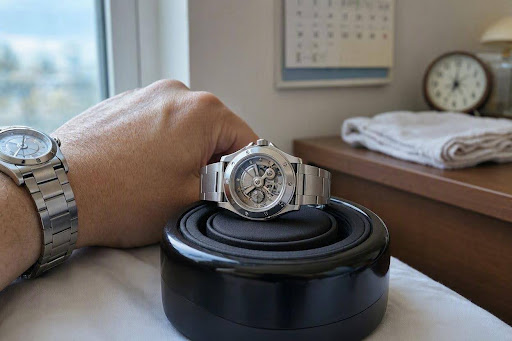
If you’ve just bought your first automatic watch, or inherited one that’s been sitting in a drawer for years, the winding question comes up almost immediately. Unlike a quartz watch that runs on a battery, an automatic relies on movement and mechanical energy to keep going, and getting the winding routine wrong can leave you resetting the date and time more often than you’d like.
The short answer: most automatic watches need winding every one to three days if they’re not being worn, though the exact figure depends on the watch’s power reserve. The longer answer involves understanding how these movements actually work, how your daily habits affect them, and what changes if you own more than one piece.
How an Automatic Watch Stores Energy
An automatic watch has a small weighted rotor inside the case that spins freely as your wrist moves. That spinning motion winds a coiled mainspring, which stores mechanical energy the same way a manual watch does when you turn the crown by hand — the difference is simply where the winding energy comes from.
Once the mainspring is fully wound, it releases that stored energy gradually to drive the gear train, the escapement, and ultimately the hands on the dial. The amount of time a watch can run on a full wind before stopping is called its power reserve, and it’s one of the most useful specifications to check before you buy or before you plan how often you’ll need to wear a piece.
So How Often Does It Actually Need Winding?
This depends almost entirely on two things: your watch’s power reserve, and how consistently you wear it.
If you wear it daily. Most people who put an automatic watch on every morning and take it off at night don’t need to think about winding at all. Normal wrist movement throughout the day is usually enough to keep the mainspring topped up, and the watch will simply keep running.
If you wear it every other day. This is where power reserve starts to matter. A watch with a 40-hour reserve should comfortably survive a day off the wrist and still be running (if a little low on power) the next time you pick it up. A watch with a shorter reserve, closer to 36 hours, is more likely to stop.
If it sits unworn for several days or longer. This is when manual winding, or a winder, becomes genuinely useful rather than optional. A watch left in a drawer for a week will stop completely, and you’ll need to reset the time and date (and on some watches, the moonphase or other complications) before wearing it again.
A quick, reliable way to check your own watch’s expected reserve is to look at the manufacturer’s specification sheet or the original box literature. Brands publish this figure because it directly affects how the watch fits into someone’s daily routine, and Longines’ own explainer on power reserve is a useful primer if you want to understand how the mainspring and barrel mechanism actually stores that energy.
Manual Winding vs Letting It Run Down
Some owners prefer to manually wind an automatic watch each morning rather than relying purely on wrist movement, particularly with pieces that have a shorter power reserve or that get worn less frequently. This is completely fine, and for many watches it’s actually recommended practice — winding the crown 20 to 30 turns brings the mainspring close to full tension, after which normal wear keeps it topped up.
The one habit to avoid is over-winding. On most modern automatics this isn’t actually possible thanks to a slipping clutch mechanism in the mainspring barrel, but you should still stop as soon as you feel resistance rather than forcing the crown further.
If you’re deciding between manually winding a watch yourself each day or using a mechanical winder to keep it running continuously, it’s worth comparing the two approaches properly rather than guessing. This breakdown of quality watch winders vs manual range goes through the practical differences, including which option suits a single daily-wear watch versus a rotating collection.
Do You Need a Watch Winder If You Only Own One Watch?
Not necessarily. If you wear the same watch every day, the natural movement from your wrist is generally all it needs, and a winder becomes more of a convenience than a requirement — useful mainly if you travel, work from home and move less than usual, or simply want to avoid resetting the time after a weekend off.
Where a winder earns its place is with complicated watches. Anything with a perpetual calendar, moonphase, or annual calendar complication is genuinely painful to reset by hand if it stops, since you may need to work through each date and month individually. For those pieces, keeping the watch running continuously on a winder saves real time and hassle.
Watch Winders and Multi-Watch Collections
Once you own more than one or two automatic watches, the winding question changes shape. You can’t wear every watch every day, which means pieces left in a drawer will inevitably run down. Rotating through a collection by hand, resetting each one before wearing it, becomes tedious fairly quickly.
This is the scenario where a proper watch winder setup makes the most sense, and it’s also where storage habits start to matter just as much as winding habits. A watch that’s wound and running but tossed loosely into a drawer is far more exposed to scratches, dust, and knocks than one kept in a dedicated tray or case. Setting up a proper storage routine alongside your winding routine, using this guide to organising watches, cufflinks, and other everyday accessories, keeps a growing collection both protected and genuinely accessible day to day.
Signs Your Winding Routine Isn’t Working
A few practical signs suggest it’s time to adjust how you’re handling a watch:
- It regularly stops between wears. If a watch you wear three or four times a week keeps stopping, its power reserve may be shorter than your current routine allows for, and either more frequent manual winding or a winder would help.
- The time is noticeably off after a day or two off the wrist. Some drift is normal for mechanical movements, but a large jump usually means the mainspring ran close to empty and the movement wasn’t running at full, consistent power.
- You’re winding it every single day regardless of wear. This isn’t a problem in itself, but if it feels like a chore, a winder removes the daily task entirely for watches that see irregular wrist time.
What Happens Inside the Watch When It Stops
It’s worth understanding why a stopped automatic watch isn’t a sign that anything has gone wrong. As the mainspring unwinds, the energy passing through the gear train gradually decreases until it can no longer overcome the friction in the escapement. At that point, the balance wheel stops oscillating and the second hand freezes in place. Nothing has been damaged, and no lubricants or components have degraded simply because the watch sat idle. Setting it going again is purely a matter of adding fresh energy, either through winding or wear, and correcting the display.
This is also why a stopped watch tells you very little about its condition on its own. A perfectly healthy movement will stop after its power reserve runs out just as readily as one that’s overdue a service. The real indicators of a movement needing attention are things like a noticeably shorter power reserve than when the watch was new, inconsistent timekeeping while it’s running, or unusual noises from the case, none of which are related to how often you wind it.
Choosing the Right Approach for Your Lifestyle
There’s no single correct answer here — the right routine depends on how many automatic watches you own, how often you wear each one, and how much friction you’re willing to tolerate before wearing a watch that’s stopped. Someone with a single daily-wear piece rarely needs to think about any of this. Someone managing a rotating collection of five or six watches, several with complications, generally benefits from investing in proper winding and storage equipment rather than manually resetting watches every few days.
Retailers like Aevitas build their watch winder and storage ranges around exactly this range of scenarios, from single-watch winders through to larger multi-watch cabinets, so it’s worth matching the equipment to how your collection actually behaves rather than buying based on watch count alone.
Final Thoughts
Winding frequency isn’t really about a fixed rule you need to memorise — it’s about matching your routine to your watch’s power reserve and how often it actually sits on your wrist. A daily-wear watch usually looks after itself. Anything worn less often, or any collection larger than one or two pieces, benefits from a bit more thought around winding and storage, whether that means a consistent manual routine or a dedicated winder. Get that balance right and an automatic watch will run accurately and reliably for years with very little effort on your part.
FAQs
How many turns does it take to wind an automatic watch by hand? Most automatic watches need roughly 20 to 30 turns of the crown to bring the mainspring to a comfortable running level. You should stop as soon as you feel resistance rather than continuing to turn.
Can you overwind an automatic watch? On the vast majority of modern automatics, no. A slipping clutch mechanism in the barrel prevents mechanical damage from overwinding. Older or vintage pieces without this feature should be wound more carefully.
Is it bad for a watch to stop running? No, letting a mechanical watch run down and stop causes no damage. It simply means resetting the time (and date, if applicable) before wearing it again.
Do watch winders damage automatic watches over time? A well-made winder set to the correct rotation direction and turns-per-day for your specific movement shouldn’t cause any wear beyond normal use. Cheap or incorrectly configured winders can occasionally cause more strain than manual winding would.
How long can an automatic watch sit before it needs winding? This depends on its power reserve, typically 38 to 80 hours for modern movements. A watch left unworn for longer than its power reserve figure will stop and need resetting.
