

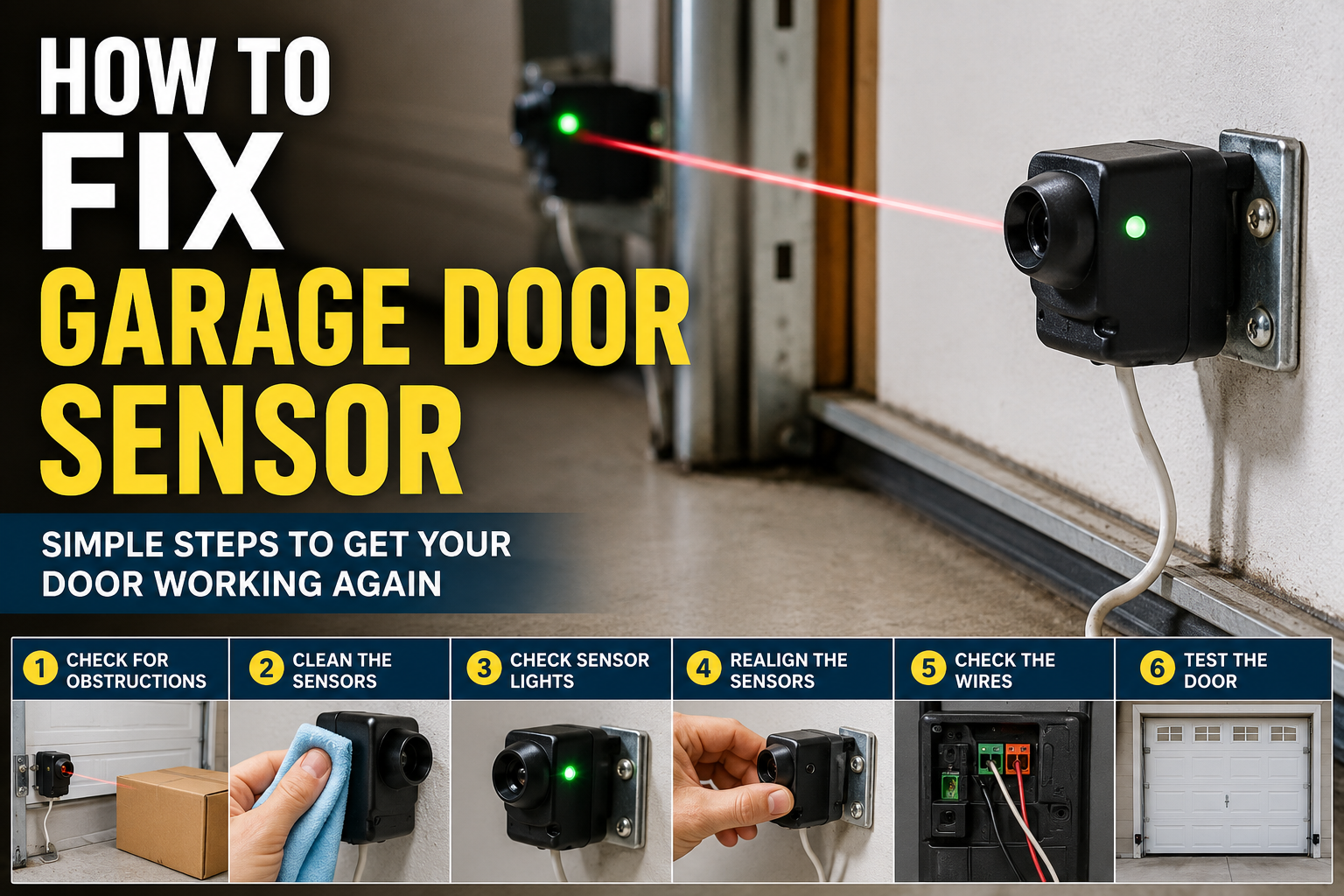
A garage door that will not close can quickly turn into a daily headache. Most of the time, the problem is not the motor or the remote. It is often the safety sensors near the bottom of the garage door tracks.
If you are searching for how to fix garage door sensor, the good news is that many sensor problems are easy to check at home. A small bit of dirt, a loose wire, or a slight misalignment can stop the whole door from working.
Think of garage door sensors like a pair of eyes. If they cannot “see” each other clearly, your opener thinks something is blocking the door. As many technicians say, “A garage door sensor does not need to be broken to stop working. It only needs to be confused.”
Below is a clear, step-by-step guide to help you find the issue and fix it safely.
What Garage Door Sensors Do
Garage door sensors are small safety devices placed near the floor on both sides of the garage door. One sensor sends an invisible beam, and the other receives it.
When something blocks that beam, the garage door opener stops the door from closing. This helps protect people, pets, cars, bikes, tools, and anything else in the doorway.
This is why your door may go down a few inches, stop, and then reverse. The opener is reacting as if something is in the way, even when the doorway looks clear.
Learning how to fix garage door sensor starts with understanding this simple idea: the sensors must be clean, lined up, powered, and connected.
Signs Your Garage Door Sensor Has a Problem
Sensor issues usually show up in very specific ways. Your garage door may open normally but refuse to close with the remote.
You may also notice that the door starts closing, then quickly goes back up. In many cases, the opener light flashes several times to warn you that something is wrong.
Common signs include:
- Garage door opens but will not close
- Door reverses before touching the floor
- Opener light keeps blinking
- Sensor lights are off, dim, or flickering
- Door only closes when you hold the wall button
- Nothing is blocking the door, but it acts like something is there
If you see these signs, the sensors should be the first thing you check.
Safety First Before You Touch Anything
Before working near your garage door, keep safety in mind. Garage doors are heavy, and openers use moving parts that can cause injury.
Do not place your hands near rollers, springs, hinges, or cables while testing the door. Also, keep children and pets away during the inspection.
For simple sensor checks, you usually do not need to unplug the opener. But if you plan to touch wires, remove sensor brackets, or clean around electrical connections, it is safer to unplug the opener first.
A useful rule is, “If you are only looking, leave it powered. If you are touching wires, cut the power.”
Step 1: Check for Anything Blocking the Sensor Beam
The easiest fix is often the one people miss. Look across the bottom of your garage door opening and make sure nothing is blocking the sensor beam.
Even a small item can cause trouble. A broom, garden hose, toolbox, cardboard box, trash bin, or bike tire can sit in the sensor path without looking obvious.
Also check for spider webs, leaves, dust, and mud near the sensor lenses. These can block the beam just enough to make the opener react.
If the area is clear, try closing the garage door again. If it works, the problem was simply an obstruction.
This is the first and fastest step in how to fix garage door sensor, because it takes less than a minute and costs nothing.
Step 2: Clean the Sensor Lenses
Garage door sensors sit close to the floor, so they collect dirt easily. Dust, moisture, cobwebs, and garage grime can cover the lens.
Use a soft, clean cloth to wipe both sensor lenses. A microfiber cloth works well because it cleans without scratching.
If the lens is sticky or greasy, use a little mild cleaner on the cloth. Do not spray cleaner directly onto the sensor, because liquid can enter the housing.
After cleaning both sensors, check the lights again. If both lights become steady, the sensors may be working again.
A dirty lens is like wearing foggy glasses. The sensor might still be powered, but it cannot see clearly.
Step 3: Look at the Sensor Lights
Most garage door sensors have small indicator lights. These lights help you understand what is happening.
Usually, one sensor has a sending light and the other has a receiving light. Depending on the brand, the colors may be green, amber, yellow, or red.
The main thing to look for is whether the lights are steady or blinking. A steady light often means the sensor is powered and lined up. A blinking or off light often points to a problem.
Check these conditions:
- Both lights steady: Sensors are likely aligned and powered.
- One light off: Power or wiring issue may be present.
- One light blinking: Sensor may be misaligned.
- Both lights off: Opener power, wires, or sensor failure may be the issue.
This step is very important when learning how to fix garage door sensor, because the lights give you clues before you start adjusting anything.
Step 4: Realign the Sensors
Misalignment is one of the most common garage door sensor problems. Sensors can get bumped by a trash can, lawn mower, bike, pet, or even vibration from the door.
The two sensors must face each other directly. If one is tilted slightly up, down, left, or right, the beam may not connect.
Loosen the wing nut or small screw holding the sensor bracket. Move the sensor gently until the indicator light becomes steady.
Do this slowly. Tiny movements can make a big difference. Once the light stays solid, tighten the bracket again.
Repeat on the other side if needed. After both lights are steady, test the garage door with the remote.
A helpful way to picture this is like pointing two flashlights at each other across a room. If one points away, the connection breaks.
Step 5: Make Sure the Sensor Brackets Are Tight
Sometimes the sensors are aligned for a moment, then move again when the door shakes. This happens when the brackets are loose.
Check both sensor brackets and make sure they are not bent, hanging, or wobbling. If a bracket is loose, tighten the screw or nut carefully.
If the bracket is bent, gently straighten it by hand. Do not force it too hard, because you may crack the sensor housing or damage the mounting point.
Once the brackets are secure, line up the sensors again and test the door.
This small step can save you from fixing the same problem again tomorrow.
Step 6: Check the Sensor Wires
If the sensor lights are off or flickering, the wires may be loose or damaged. Sensor wires are usually thin and run from each sensor back to the opener unit.
Look for cuts, breaks, staples through the wire, loose connections, or chew marks from pests. Also check where the wires connect to the back of the opener.
If a wire is loose at the sensor or opener, reconnect it firmly. Make sure the wire ends are clean and seated properly.
If you see badly damaged wiring, it is better to replace the wire or call a garage door technician. Damaged wiring can create repeat problems and may not be safe.
When people ask how to fix garage door sensor, wiring is often the step that separates a simple fix from a repair that needs professional help.
Step 7: Check for Sunlight Interference
Direct sunlight can sometimes hit the receiving sensor and confuse it. This usually happens at certain times of day.
For example, your garage door may work fine in the morning but refuse to close in the afternoon. That is a strong clue that sunlight may be affecting the sensor.
You can test this by shading the sensor with your hand while someone tries to close the door from a safe distance. Do not stand under the door.
If shading the sensor helps, you may need a sensor sun shield. Some homeowners also swap the sending and receiving sensors, but this depends on the opener model.
The simple idea is to stop bright light from overpowering the sensor beam.
Step 8: Dry the Sensors If They Got Wet
Water can also cause sensor trouble. Heavy rain, snow, humidity, or garage washing can make the sensor lens or wiring damp.
Wipe the outside of both sensors with a dry cloth. Check the lens, bracket, and wire connection points.
Let the sensors dry fully before testing again. If moisture keeps entering the sensor, the housing may be cracked or the sensor may need replacement.
Garages are not always perfectly sealed, so moisture problems can happen more often in winter, rainy seasons, or humid areas.
Step 9: Reset the Garage Door Opener
Sometimes the opener needs a simple reset after a sensor error. This is not always required, but it can help after cleaning or realigning the sensors.
Unplug the garage door opener from the power outlet. Wait about one minute, then plug it back in.
After power returns, check the sensor lights and try closing the door again.
A reset will not fix broken parts, but it can clear small glitches. It is like restarting a phone when an app freezes.
This is another easy step in how to fix garage door sensor before you spend money on parts.
Step 10: Test the Door the Right Way
After making changes, test the door carefully. Stand away from the door opening and use the remote or wall button.
The door should close smoothly without reversing. The sensor lights should remain steady while the door moves.
Next, test the safety feature. Place a soft object, like a cardboard box, in the door’s path. The door should stop and reverse when the beam is blocked.
Do not use your foot, hand, or body to test the sensors. A garage door is too heavy for that risk.
If the door passes this test, your sensors are likely working correctly.
When You May Need to Replace the Sensors
Sometimes cleaning and alignment are not enough. Sensors can wear out, crack, or fail internally.
You may need replacement sensors if:
- The lights stay off even with power
- The lenses are cracked
- The sensor housing is broken
- The wires are good but the sensor still fails
- The sensor works sometimes and fails randomly
- The door still reverses after all basic fixes
Replacement sensors are usually not too expensive, but they must match your opener brand and model. Using the wrong sensors may create more problems.
If you are not sure which sensors to buy, check the opener manual or look up the model number on the opener motor unit.
When to Call a Professional
You can handle many sensor problems yourself, but some issues need a trained technician.
Call a professional if the door closes unevenly, the opener makes strange sounds, the tracks are bent, or the door feels heavy. These may not be sensor problems at all.
Also call for help if you see damaged springs, broken cables, loose rollers, or serious wiring issues. These parts can be dangerous to repair without proper tools.
A good way to think about it is, “Clean, align, and inspect at home. Repair springs, cables, and major wiring with a professional.”
Knowing how to fix garage door sensor is helpful, but knowing when to stop is just as important.
Common Mistakes to Avoid
Many homeowners make sensor problems worse by rushing the repair. Take your time and avoid forcing parts.
Do not tape sensors together to trick the opener. This removes an important safety feature and can put people, pets, and property at risk.
Do not ignore blinking lights. They are warning signs, not random flashes.
Do not keep holding the wall button every day just to force the door closed. That may bypass the sensor system temporarily, but it does not solve the real issue.
Also, do not assume the opener is broken right away. Sensors are often the simplest and cheapest thing to fix first.
Quick Troubleshooting Checklist
Use this checklist when you want a fast review:
- Clear anything blocking the doorway
- Wipe both sensor lenses
- Check if sensor lights are steady
- Realign both sensors
- Tighten loose brackets
- Inspect wires for damage
- Protect sensors from direct sunlight
- Dry sensors after rain or moisture
- Reset the opener
- Test the door safely
If you follow these steps in order, you can solve many common sensor issues without guessing.
Why Garage Door Sensors Stop Working So Often
Garage door sensors are small, but they live in a rough area. They sit near the floor where dust, tools, shoes, water, and storage items are common.
They also depend on perfect alignment. Even a light bump can move one sensor enough to break the beam.
This is why the problem can seem sudden. Yesterday the door worked. Today it will not close. In reality, something small may have shifted.
The good news is that small problems often have small fixes. That is why learning how to fix garage door sensor can save time, stress, and service costs.
How to Prevent Future Sensor Problems
Once your sensors work again, a little maintenance can help prevent the issue from coming back.
Wipe the lenses once a month, especially if your garage gets dusty. Keep boxes, bikes, and tools away from the sensor path.
Check the brackets after moving large items in or out of the garage. Many sensors get knocked out of place during normal garage use.
You should also look at the wires a few times a year. Make sure they are not loose, pinched, or damaged.
Good sensor care takes only a few minutes, but it can prevent that frustrating moment when the door refuses to close while you are trying to leave.
Final Thoughts
If your garage door will not close, do not panic. The sensor may only need a quick cleaning, small alignment, or simple wire check.
Start with the easy steps first. Clear the path, clean the lenses, check the lights, and line up the sensors. These fixes solve many common issues.
If the sensors still do not work after basic troubleshooting, the sensor may be damaged or the wiring may need attention.
By following this guide on how to fix garage door sensor, you can handle simple problems with confidence and know when it is time to call a professional.
