

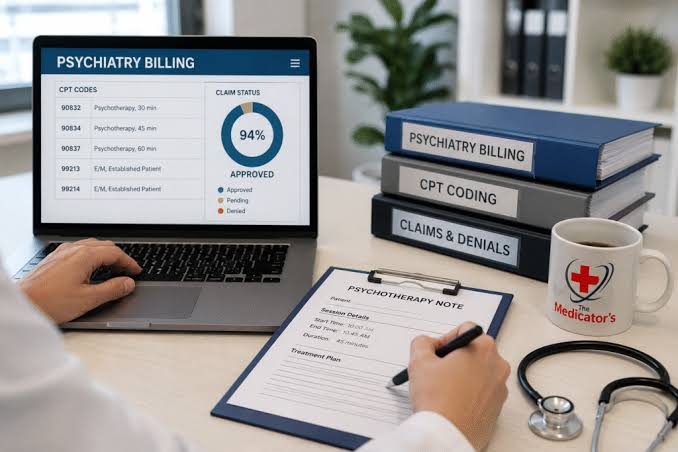
Mental health care has moved into the mainstream of American healthcare conversations, and with that shift has come a surge in psychiatric visits, telehealth sessions, and integrated behavioral health programs. But behind every session note and treatment plan sits a billing process that determines whether a practice gets paid accurately and on time. Documentation, coding, and provider roles are no longer optional for psychiatrists, psychologists, and behavioral health administrators. It’s the difference between a healthy revenue cycle and a practice caught in denials.
This guide breaks down what makes psychiatric billing distinct from general medical billing, the codes that matter most, and how each member of a care team contributes to a clean claim.
Why Does Psychiatric Billing Work Differently?
Psychiatric treatment is based not only on physical symptoms, but on the time, complexity, and clinical judgment. A psychiatrist could spend 45 minutes managing medication, assessing risk, and fine-tuning a treatment plan, without a patient’s knowledge, which would appear neither on an X-ray nor on a lab report. That means documentation is the lifeblood of every claim, and it is particularly crucial on a mobile platform.
Payers want to know medical necessity is clearly defined: the diagnosis, why the visit, interventions discussed, and what is planned next. Anything that sounds like “patient doing okay, continue meds” is not useful for auditing. Detailed documentation can be used to protect the provider and patient and can directly impact the codes billed on the claim.
The Documentation Standards That Matter Most
Each psychiatric interaction should contain some essential components: chief complaints, mental status exam results, risk assessment, diagnosis including the rationale, and a documented treatment plan. If a patient is in therapy, the note should include the type of therapy, such as cognitive behavior, supportive therapy, family therapy, and the patient’s reaction to the therapy.
Documentation by time is particularly important. Many psychiatric CPT codes are based on the length of a session, and if the note does not designate a start and end time or indicate the total number of minutes spent, the claim may be downcoded or denied. This practice will save your billing teams a lot of back-and-forth later if it becomes a habit for providers.
Core CPT Codes Used in Psychiatry
Most of the psychiatric coding is done with a relatively small number of CPT codes. Medication management and general office visits are coded under the evaluation and management codes (99201–99215).
Medical services are included in the psychiatric diagnostic evaluation (90792), which is billed separately from a psychiatric diagnostic evaluation (90791).
The different psychotherapy codes are defined by the duration of the session, which is generally 30 minutes (90832), 45 minutes (90834), and 60 minutes (90837).
Role of Add-on codes. Interactive complexity applies if the communication is with others, such as a parent/guardian, or if there are barriers to communication, such as differences in language. There are codes for crisis psychotherapy for emergencies. Selecting the appropriate combination of primary and add-on codes is both clinically correct and requires an understanding of the rules of add-on codes as they relate to the different payers, as not all payers utilize the same rules for reimbursement.
ICD-10 Coding and Diagnostic Precision
Diagnosis coding in psychiatry carries its own layer of nuance.
A single ICD-10 code rarely tells the whole story, since many patients present with overlapping conditions such as generalized anxiety disorder alongside major depressive disorder, or a substance use disorder alongside a mood disorder. Coders should incorporate the entire clinical scenario but not overcode or include conditions not being addressed during the visit.
Behavioral health is often the main diagnosis, but psychiatric patients also may come in with somatic complaints for which they receive an additional diagnosis code. If a patient presents with chronic tension in addition to anxiety, then this could be a separate code for the physical symptom. But general medical icd 10 code for headache knowledge is important as well; when a provider is documenting a symptom such as this, he or she must use the right code, R51, and get it right along with the psychiatric diagnosis, so that the claim will accurately represent what was covered in the visit.
Compliance is not the only consideration when getting it right. Correct diagnosis coding facilitates continuity of care, aids in treatment planning, and provides a comprehensive view of the patient’s overall healthcare status to other providers.
Who Does What in the Billing Cycle?
Clean claims seldom result from the efforts of a single individual. Documentation of psychiatric/prescriber is important for medical necessity and accurate time tracking. Consistency in therapists’ and clinical staff’s documentation of session information, particularly modality and duration. Eligibility and prior authorizations are very important in behavioral health because the process of getting prior authorization is a requirement for many therapy frequencies or levels of care by many payers, and front-office staff is responsible for the process.
Billing and coding specialists translate all of that clinical information into compliant codes, catch inconsistencies before submission, and follow up on denials. When these roles operate independently rather than as a coordinated system, small gaps in communication turn into large gaps in reimbursement. Many practices find that outsourcing this coordination to dedicated psychiatry billing services closes those gaps, since specialized teams understand payer-specific behavioral health rules that general medical billers may not encounter regularly.
Common Reasons Psychiatric Claims Get Denied
There are some patterns that repeatedly occur in psychiatric claim denials. Common causes include missing or incomplete session time documentation, as well as mismatched procedure/diagnosis documentation that do not support one another. Another frequent problem is lapses in authorization for patients who are under more frequent treatment or who are part of treatment programs such as intensive outpatient treatment.
Billing for telehealth also presents its own challenges, as there are place-of-service codes and modifiers for each payer, and each has experienced changes in recent years. The constant changes in these rules – often where practices are most helpful with medical billing for psychiatrists- demand constant attention to keep current with these changes and prevent them from becoming denied claims.
Building a Sustainable Approach
Psychiatric billing sits at the intersection of clinical nuance and administrative precision. Strong documentation habits, accurate CPT and ICD-10 coding, and clear role definition across the care team form the foundation of a billing process that actually works. Practices that treat psychiatric billing as a specialized discipline, rather than an extension of general medical billing, tend to see fewer denials, faster reimbursement, and less administrative strain on clinical staff.
Whether you’re running a solo psychiatric practice or managing a growing behavioral health group, investing time in documentation training and coding accuracy pays off in a more stable, predictable revenue cycle. If your team is spending more time chasing denials than treating patients, it may be time to bring in dedicated psychiatric billing expertise built specifically for behavioral health.
