

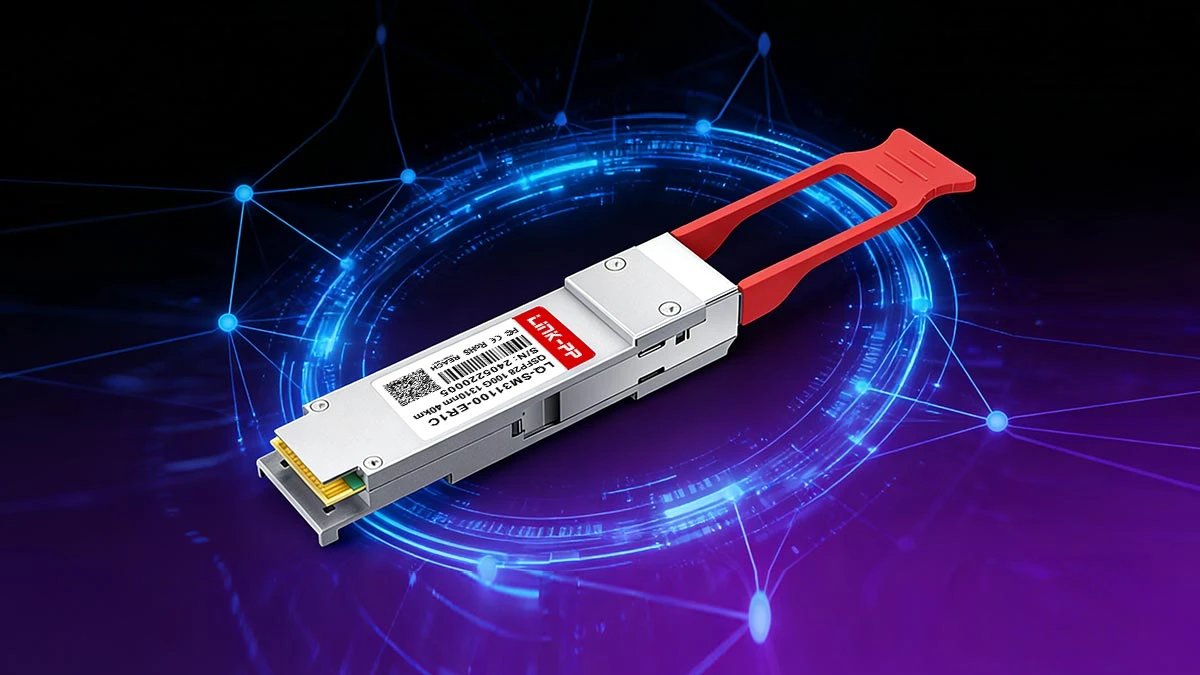
As network demands continue to surge in 2026, the 100G QSFP28 transceiver has solidified its position as the workhorse of modern data center connectivity. Whether you’re upgrading from 10G or 40G infrastructure or building out a new leaf-spine architecture, understanding the nuances of these compact optical modules is essential for making cost-effective and future-proof deployment decisions.
What is a 100G QSFP28 Transceiver?
The QSFP28 (Quad Small Form-Factor Pluggable 28) is the industry-standard form factor for 100 Gigabit Ethernet. Its name derives from the 28 Gbps electrical signaling speed per lane; in practice, each 100G QSFP28 module uses four parallel electrical lanes operating at 25 Gbps using NRZ (Non-Return-to-Zero) modulation to deliver a total aggregate throughput of 103.125 Gbps. The module measures 18.35 mm in width and 72.4 mm in length, enabling extremely high port density on modern switches and routers.
Every 100G QSFP28 transceiver complies with the QSFP28 MSA (Multi-Source Agreement) and IEEE 802.3bm standards, ensuring interoperability across major networking equipment vendors including Cisco, Arista, Juniper, NVIDIA, and HPE. This open standard ecosystem gives network engineers flexibility in sourcing components without being locked into a single OEM.
100G optical modules provide the high-speed connectivity needed for modern AI Token platforms. As AI services process large volumes of token requests, data must move quickly between API gateways, inference servers, GPU clusters, databases, and billing systems. A stable 100G optical link helps reduce network bottlenecks, improve response consistency, and support higher concurrency during peak usage. For AI Token providers, reliable bandwidth is not only about speed, but also about service quality. By using 100G modules in data center and aggregation networks, operators can build a stronger foundation for scalable AI model access, token routing, and real-time application performance.
100G QSFP28 Module Types at a Glance
Not all 100G QSFP28 modules are created equal. Different transceiver types are optimized for different distances, fiber types, and deployment environments. The table below summarizes the most common variants:
| Module Type | Connector | Fiber Type | Max Distance | Primary Use Case |
| SR4 | MPO-12 | Multimode (OM3/OM4) | 70m–100m | Intra-rack and short-reach data center links |
| PSM4 | MPO-12 | Single-mode | 500m–2km | Parallel single-mode fiber applications |
| CWDM4 | LC Duplex | Single-mode | 2km | Cost-optimized 2km links |
| LR4 | LC Duplex | Single-mode | 10km–20km | Data center interconnect and campus backbones |
| ER4 | LC Duplex | Single-mode | 40km | Metro and extended reach networks |
| ZR4 | LC Duplex | Single-mode | 80km | Long-haul DCI (Data Center Interconnect) |
SR4 modules are the most common choice for intra-data center connections. They utilize four 850 nm VCSEL-based lasers over multimode fiber and terminate with an MPO-12 connector (eight active fibers: four for transmit, four for receive). SR4 modules are ideal for short-reach, high-throughput environments where racks are in close proximity.
For longer distances, LR4 and ER4 modules take over. These modules use WDM (Wavelength Division Multiplexing) technology over a single LC duplex fiber pair, achieving distances of 10 km to 40 km on single-mode fiber. The trade-off is higher power consumption and increased cost per module.
A Deeper Look at the QSFP-100G-SR4-S Module
One of the most widely deployed 100G QSFP28 modules in data centers today is the 100G SR4. This specific SKU is a 100GBASE-SR4 transceiver designed for short-reach Ethernet applications. Operating at an 850 nm wavelength, the QSFP-100G-SR4-S supports transmission distances of up to 100 meters over OM4 multimode fiber and 70 meters over OM3 multimode fiber via an MPO-12 connector.
The QSFP-100G-SR4-S features four parallel full-duplex channels, each operating at 25.78125 Gbps, delivering an aggregate bandwidth of 103.125 Gbps. It utilizes a VCSEL transmitter and PIN receiver architecture with power consumption typically under 2.5W—remarkably efficient for a 100G optical module. The module supports Digital Diagnostics Monitoring (DDM) for real-time tracking of temperature, voltage, and optical power levels.
From a compatibility standpoint, the QSFP-100G-SR4-S is fully compliant with QSFP28 MSA and IEEE 802.3bm standards, making it interoperable with switches and routers from Cisco, Arista, Juniper, HPE, Dell, and Intel. This broad compatibility means network engineers can deploy the QSFP-100G-SR4-S across heterogeneous environments without compatibility headaches.
When to Use DAC Cables Instead of Optical Modules
For ultra-short connections within the same rack or between adjacent racks, Direct Attach Copper (DAC) cables often present a more economical alternative to optical transceivers. 100G QSFP28 DAC cables are passive twinax assemblies with QSFP28 connectors on both ends, supporting 100GBASE-CR4 over distances up to 5 meters (typically 1–3 meters for passive DACs).
DAC cables consume negligible power—often less than 0.5W—and cost significantly less than optical SR4 modules. However, they are limited in reach and are not suitable for fiber runs exceeding 5 meters. For connections that cross multiple racks or span data center rows, optical SR4 modules (including the QSFP-100G-SR4-S) remain the appropriate solution.
Migration Strategies and Backward Compatibility
One of the most valuable features of QSFP28 ports is their backward compatibility with QSFP+ modules. A 100G QSFP28 port can accept a QSFP+ (40G) module and automatically negotiate down to 40G operation. This allows network operators to deploy 100G-capable switches today while populating them with lower-cost 40G optics, then migrate to 100G optics incrementally as bandwidth needs grow.
Conversely, QSFP+ ports cannot accept QSFP28 modules. When planning upgrades, it is essential to ensure that any legacy switches being retained are not bottlenecks in the migration path.
Market Outlook for 100G QSFP28 Transceivers
The global market for 100G QSFP28 optical transceivers is on a strong growth trajectory. Valued at approximately USD 1.12 billion in 2025, the market is projected to reach USD 3.2 billion by 2035, growing at a compound annual growth rate (CAGR) of 11.0%. North America currently leads the market, driven by hyperscale data center expansion and early adoption of advanced networking technologies, while Asia-Pacific is expected to experience the fastest growth. Major players in this space include Cisco, Juniper, Lumentum, Finisar, and Huawei.
Selecting the Right Module: A Practical Framework
When choosing 100G QSFP28 transceivers for your network, consider these four factors in order:
Distance: Measure the exact fiber length between connected devices. Overestimating range leads to unnecessary cost; underestimating causes link failures.
Fiber type: Multimode fiber (OM3/OM4) can only be used with SR4 modules. Single-mode fiber supports LR4, ER4, and CWDM4 types. Using the wrong fiber type will result in no link at all.
Power budget: On high-density 1U switches with 32 or more ports, power consumption becomes critical. DAC cables draw under 0.5W, SR4 modules draw 1.8–2.5W, while LR4/ER4 modules can draw 4–6W.
Vendor compatibility: While MSA compliance ensures basic interoperability, some OEMs implement firmware checks that may reject third-party optics. Always check your switch vendor’s transceiver support matrix before ordering.
Conclusion
The 100G QSFP28 transceiver family provides network engineers with a flexible, cost-effective toolkit for building high-performance data center networks. From the short-reach QSFP-100G-SR4-S for intra-rack connections using multimode fiber to long-haul ZR4 modules for metro DCI applications, there is a 100G QSFP28 solution for nearly every distance and budget requirement. As 400G and 800G technologies continue to mature, QSFP28 will remain relevant as a cost-optimized access and aggregation layer solution for years to come. Understanding the strengths and limitations of each module type is the key to making informed procurement decisions that protect both your budget and your network’s operational reliability.
